Have you ever been in a group conversation where you can hear people talking, but you still have to keep turning your head to work out who is speaking?
For some people with hearing loss, following a conversation is not simply about making voices louder. It can also involve constantly working out where sounds are coming from, who is speaking and which voice to concentrate on. This can make social situations tiring, particularly in places such as restaurants, family gatherings or busy workplaces.
Hearing aids may help by making speech more accessible, but how much they help with conversation depends on the type and degree of hearing loss, the listening environment and how the devices are fitted and adjusted.
Key takeaways
- Hearing loss can make it harder to work out where a voice is coming from, not just hear the voice itself.
- Hearing aids may make speech more accessible and can provide support in conversations, including situations with background noise.
- Hearing aids do not eliminate every listening challenge, particularly when several people are speaking at once or the environment is noisy.
- The benefit of hearing aids depends on factors such as your hearing loss, the listening environment, and how the devices are fitted and adjusted.
- When considering hearing aids, it helps to discuss the specific situations you find difficult, rather than focusing only on the device or its features.
Why does knowing where a voice is coming from matter?
Your two ears normally receive slightly different information about a sound. Your brain uses these differences to help work out the direction of a voice or other sound.
When hearing is reduced, particularly when the ears hear differently from each other, this process can become more difficult. You may find yourself looking around before responding because you are trying to identify who has spoken.
This is one reason that hearing clearly and locating sound are related, but not exactly the same thing.
Can hearing aids make conversations feel less mentally demanding?
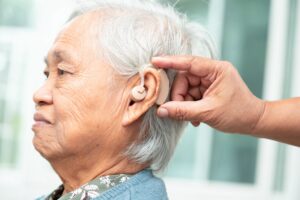
Hearing aids are designed to amplify sounds according to an individual’s hearing needs. Depending on the device and how it is programmed, features may also help manage background noise and make speech easier to hear in particular listening situations.
This can be relevant when several people are speaking at once. Instead of relying entirely on visual clues or repeatedly turning towards each speaker, you may have more audible information available to help you follow the conversation.
However, hearing aids do not recreate normal hearing. In a busy environment, voices can still overlap with background sounds, and identifying the speaker may remain difficult.
The aim is therefore not to expect a hearing aid to make every conversation effortless. A more realistic question is whether it can make everyday listening more manageable for your particular hearing needs.
Why might one person find conversations easier than another?
The result is not determined by the hearing aid alone. Factors that may matter include,
- The pattern and severity of hearing loss
- Whether one or both ears are affected
- How well the hearing aids are fitted and adjusted
- The acoustics of the environment
- The number of people speaking
- Distance between you and the person speaking
- Your ability to see the speaker’s face and use visual cues
This is also why simply choosing a device based on its advertised features may not answer the real problem. A hearing assessment and appropriate fitting can help determine what type of support may be suitable.
What about Signia hearing aids in Singapore?
If you are considering Signia hearing aids in Singapore, the more useful starting point is not simply asking which model is best. Consider what you actually struggle with. Is it following one-to-one conversations? Hearing in restaurants? Knowing who is speaking in a group? Or keeping up when several people are talking?
Explaining these situations during an assessment can help the hearing professional understand the listening difficulties you want to address and consider suitable hearing-aid options.
Frequently Asked Questions
Can hearing aids help me hear people speaking behind or beside me?
They may make sounds more accessible, but this does not mean you will always identify the direction of every voice accurately. The result depends on your hearing, the device and the listening environment.
Why can I hear someone but still not understand what they are saying?
Hearing speech and understanding speech in noise are different challenges. Background sounds, overlapping conversations and reduced hearing can all make speech harder to follow.
Will hearing aids make restaurants and family gatherings easy to follow?
They may provide useful hearing support, but noisy environments can remain challenging. Expectations should be individual rather than assuming that hearing aids will remove all listening difficulties.
Will my hearing aid need to be adjusted again?
It may. Your experience after wearing the device in different situations can provide information that may be useful during follow-up fitting or adjustments.
Do I need hearing aids if I mainly struggle in groups?
Not necessarily. The reason for difficulty in groups needs to be considered in the context of your hearing assessment and everyday listening needs.
Schedule a consultation to better understand about hearing aids
The question is not only, “Can I hear louder?”. It is also, “Can I follow the people I need to listen to without constantly working so hard to work out what is happening?”
If conversations have become increasingly tiring or difficult to follow, an assessment can help clarify what may be contributing to the problem and whether hearing aids are appropriate for you.
For readers in Singapore, Clariti Hearing Professionals, with Ronald Pang, Katherine and Alfred Tan, can provide an opportunity to discuss your hearing concerns and explore suitable options based on your individual needs.